
The Price is Right
I’ve talked about growing up in Napoleon, OH, and that’s where I lived through most of my childhood development through the age of 18. However, I was born in Willoughby Hills, OH and moved to Napoleon at age 4. I was born in 1972 and my parents were just starting married life. In 1973, my dad was granted an assistantship at John Carroll University. He worked on his graduate degree in Psychology. In order to support our fledgling family, my mom substitute taught at what they called “The Cuyahoga Boys School”. The Boys School was a juvenile detention center, offering education and treatment to boys in the juvenile justice system. As a result, my mom had to find a babysitter for me, and later for my sister Sephora, born in 1974.
My mom was a member of the “La Leche League”, an organization offering breastfeeding support. This was during a time when instant formula was being promoted as better for baby health than the real thing. In any case, a lady in the group provided mom with a babysitting contact - Frank and Mary Barbo. Frank and Mary lived in Wickliffe, OH and I recall being dropped off there and the TV being on throughout the day. I was very young, and I don’t have too many memories of those days. But I do vividly remember The Price is Right on TV. I used ChatGPT to jog my memory, having no recollection of the fact that the Price is Right started in 1972 as a 30-minute show. The 30-minute show, which aired until it was made an hour in late 1975, didn’t include the spinning of the “Big Wheel” to determine the showcase showdown finalists. Instead, there were three pricing games. The final two contestants in the final showcase were determined by the highest winnings in those pricing games.
If you’ve ever watched the show, you know that these pricing games involve determining which everyday consumer products are underpriced or overpriced. Skill in this analysis leads to the chance to determine the price of more exciting products and services such as trips, cars, boats and expensive household items - everything from jacuzzis to elaborate refrigerators. The game requires contestants to figure out these prices, or at least get close, without going over.
————————————————-
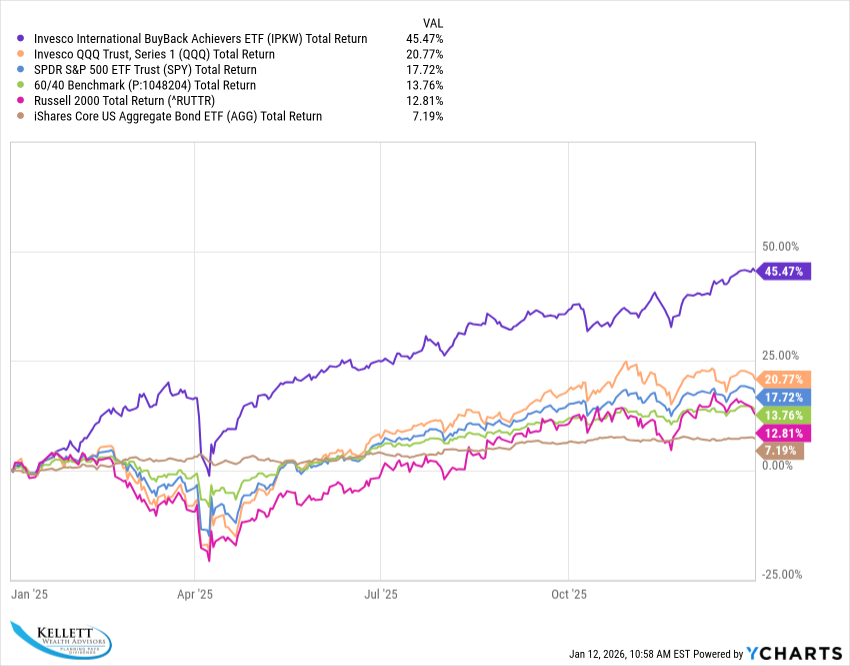
As we start 2026, it’s a cottage industry to predict where the market will go. But before we go there, here’s a short recap of 2025. Despite the tariff tantrum that roiled the markets in early April the S&P rebounded and returned a healthy 17%. If you watch the pundits and prognosticators on TV, they all would love to see small caps outperform. In fact, for the past 3 years, they have predicted small caps are just about to break out. Despite their cheerleading, the Russell 2000 trailed the S&P, up 13%. Relatedly, despite predictions otherwise, technology continued higher with a 20% return. There are two interesting outliers. Even though the S&P did well, it was blown away by international stocks. The international fund that we favor was up over 45%! Finally, while it doesn’t get the press that the more exciting S&P gets, the bond market had a nice year, up over 7%. Because of this, the traditional 60/40 portfolio - 60% stocks, 40% bonds - did very well, returning almost 14%. If you are in retirement and using the cash flow from your portfolio, this 14% is probably the most relevant return because you got a risk adjusted return that is equal or better than being invested solely in stocks.
What does 2026 hold?
No one really knows. They can say they do, but as I mentioned before, small caps have been on everyone’s “buy” list for 3 years, only to be disappointed by underperforming. It does appear though, that the US is headed for lower interest rates. President Trump has made it clear that he wants lower interest rates to boost home sales and investment by smaller companies that will increase economic growth.
If the US lowers interest rates, the value of the US dollar against other currencies is likely to drop. Why is this so? The value of the US dollar against other currencies is like a global popularity contest. When investors want to hold US assets, the dollar goes up. When they look elsewhere, it declines. If the US lowers interest rates, investors might take their money out of US Treasury bonds and move them to a currency where the rates remain higher.
This is a simplified explanation of why the dollar might decline. There are other factors in 2026 that could push the dollar lower including US inflation, budget deficits, geopolitical and policy uncertainty, and a shift in the need for investors to invest in the US as a “safe haven”. Said another way, if the rest of the world is doing relatively well, there’s less need to park money in US assets.
Which Assets are Likely to do well if the Dollar declines?
When the US dollar declines, it usually triggers a "rebalancing" of global capital. Investors move money out of US-denominated cash and bonds and into assets that either hold intrinsic value (like gold) or benefit from cheaper US exports and stronger foreign currencies.
Gold & Silver: Gold is the classic "anti-dollar." Since gold is priced in dollars globally, a weaker dollar makes gold cheaper for foreign buyers, driving up demand and the dollar-denominated price. Gold is already up huge in the past 5 years so it may not have as far to run. Silver had an astronomical 2025, up 145% in 2025.
International & Emerging Market (EM) Equities: A weak dollar provides a "currency tailwind." When you invest in a German or Japanese company and their currency (Euro or Yen) rises against the dollar, your investment is worth more when converted back to dollars.
Commodities: Oil, copper, and agricultural products are priced in US dollars. When the dollar drops, these commodities usually rise in price to maintain their value in other currencies.
US Multinational Stocks: Companies like Apple, P&G or Coca-Cola that earn a huge chunk of their revenue abroad benefit. When they bring their foreign profits back to the US, those Euros and Pounds convert into more dollars, boosting their earnings reports.
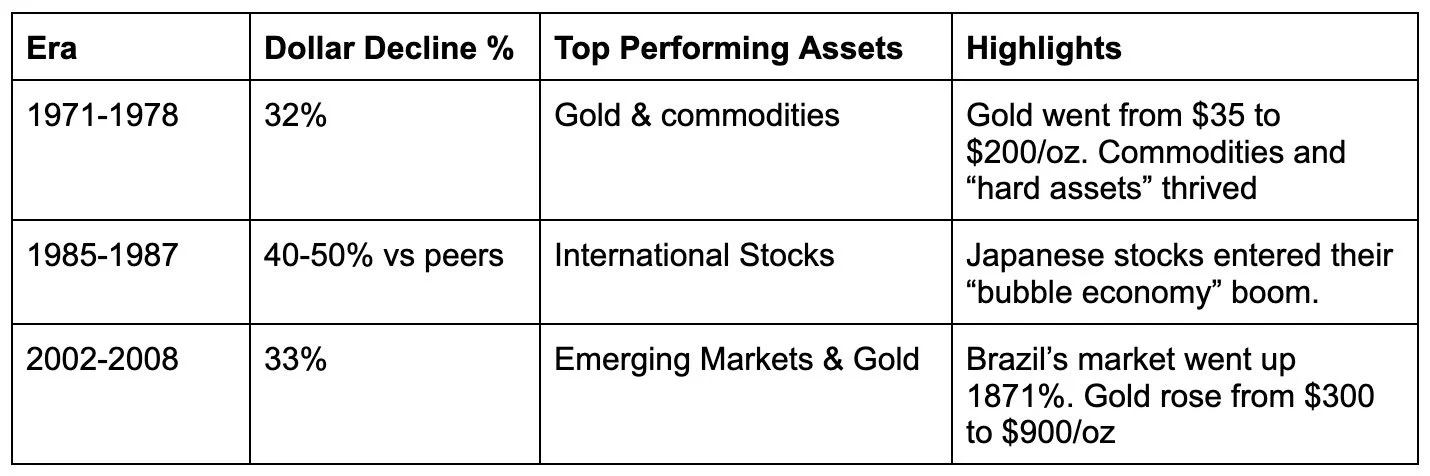
What has happened historically when the Dollar declines?
Historically, the dollar moves in long "cycles." Here are three notable periods of decline and how assets responded:
Summary:
The great Yankee Yogi Berra was quoted as saying “It’s tough to make predictions, especially about the future”. US tech stocks have been written off many times as overvalued. It’s entirely possible that lower interest rates and the dollar will continue to benefit the tried and true tech stocks. And yet, if the dollar does decline, Bob Barker might be there to say “Small caps, international stocks, gold, copper, platinum…… you’re the next contestants on The Price is Right”.
Jared